Temple of Literature – Quoc Tu Giam is no longer a strange name for Hanoi’s lovers, referring to this place, everyone will immediately think of the talented and virtuous people who are listed on the stone turtles. This is not only a tourist destination, but the Temple of Literature is also a “cradle” showing diligence, hard work, day and night to promote promotion, brocade robes to the village, is the dream of many “talented” people at that time.
The Temple of Literature started construction in 1070 under King Ly Thanh Tong. It is known that the Temple of Literature is the place to worship the saints and masters of Confucianism such as Confucius, Manh Tu, and Chu Van An, in addition, this was also the first royal school at that time. The first student to study here was Crown Prince Ly Can Duc, the son of King Ly Thanh Tong, who was only 5 years old at that time. In 1072, he ascended the throne and took the title Ly Nhan Tong. At first, the school was only to serve only the children of the king, or the nobles in the dynasty. During the reign of King Tran Thai Tong, the Temple of Literature was accepted to take in the children of ordinary people with excellent academic ability.

The Temple of Literature stretches on an area of ​​54331 m2, including many architectural works, including Literature Lake, Well of Heavenly Clarity, Constellation of Literature pavilion, Stelae of Doctors, Attained Talent gate, Imperial academy, Crystallization of Letters gate, Accomplished Virtue gate and The Great Middle gate.

Sightseeing areas in Temple of Literature.

The main gate of the Temple of Literature is built in the style of a three-arched-entrance gate, above there are 3 words “Temple of Literature” in ancient Chinese language. The Temple of Literature is surrounded by brick walls. Inside there are also walls divided into 5 zones, each area has a separating wall and a gate.
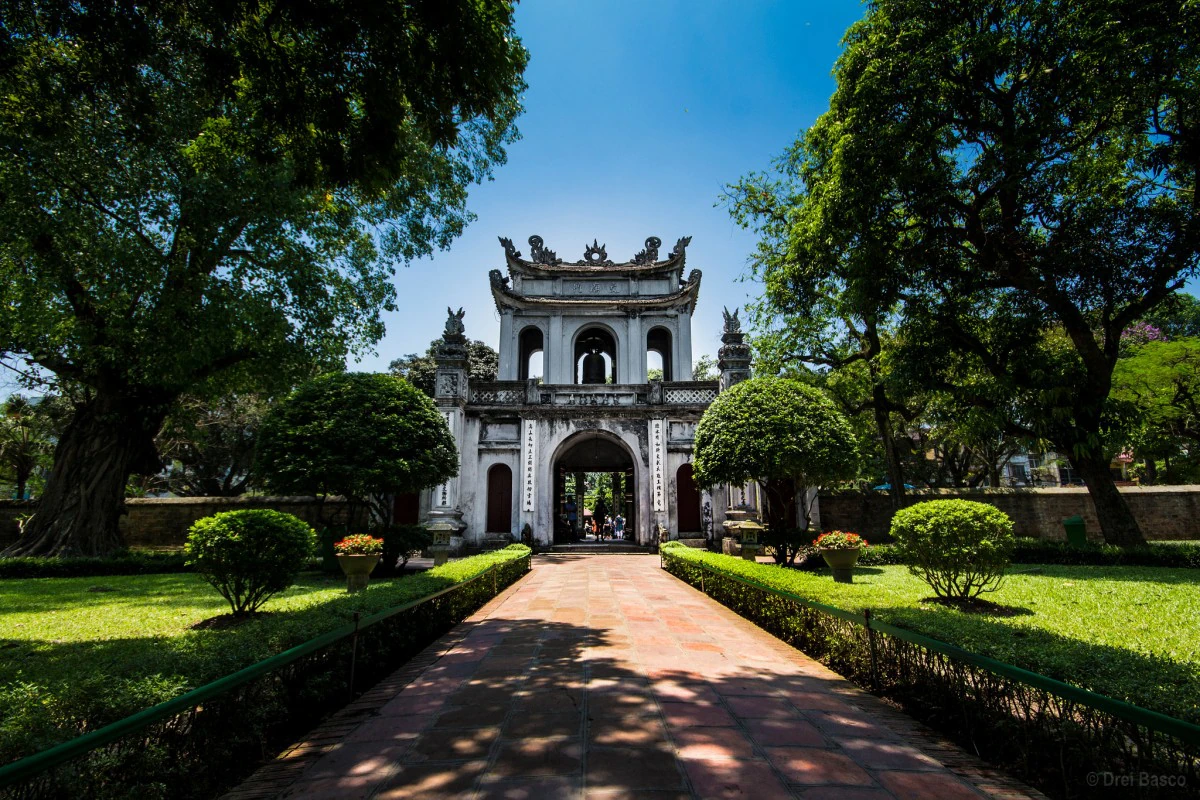


First zone

Starting with the main gate of the Temple of Literature Gate, go to the Great Middle gate, two small doors are Accomplished Virtue gate and Attained Talent gate.
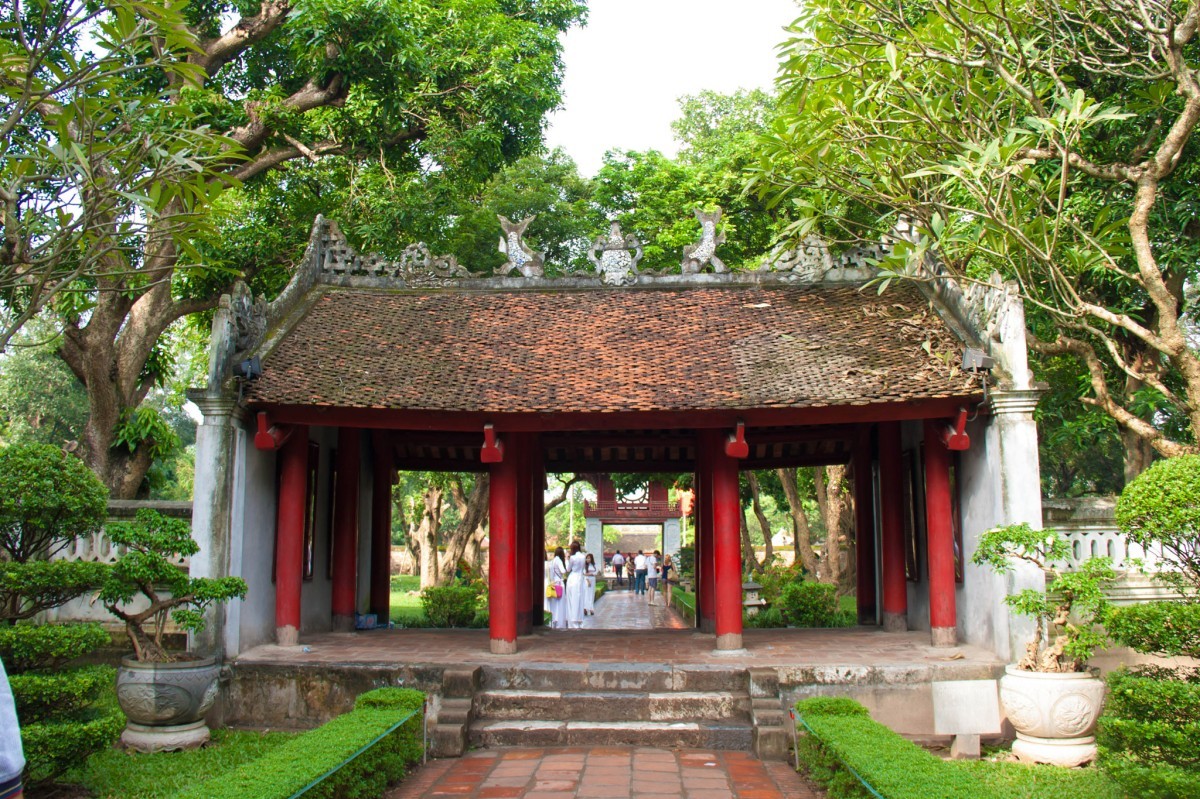


Second zone:

From the Great Middle gate to the Constellation of Literature pavilion. The Constellation of Literature pavilion is an architectural work that, although not massive, has harmonious and beautiful proportions. The architecture consists of 4 square brick pillars (85cm x 85cm) below supporting the upper floor, with beautiful wooden structures. The upper floor has 4 round doors, a row of handrails and a simple, rustic wooden roof support. The roof tile overlaps two layers to form a construction of 8 roofs, roof ledge and flat roof surface. The attic is a square floor with eight roofs, four sides of the attic wall are round windows in the shape of the sun radiating rays. To the right and left of the Constellation of Literature pavilion are Magnificence of Letter and Crystallization of Letters gate leading to two areas of Doctor’s stele house.
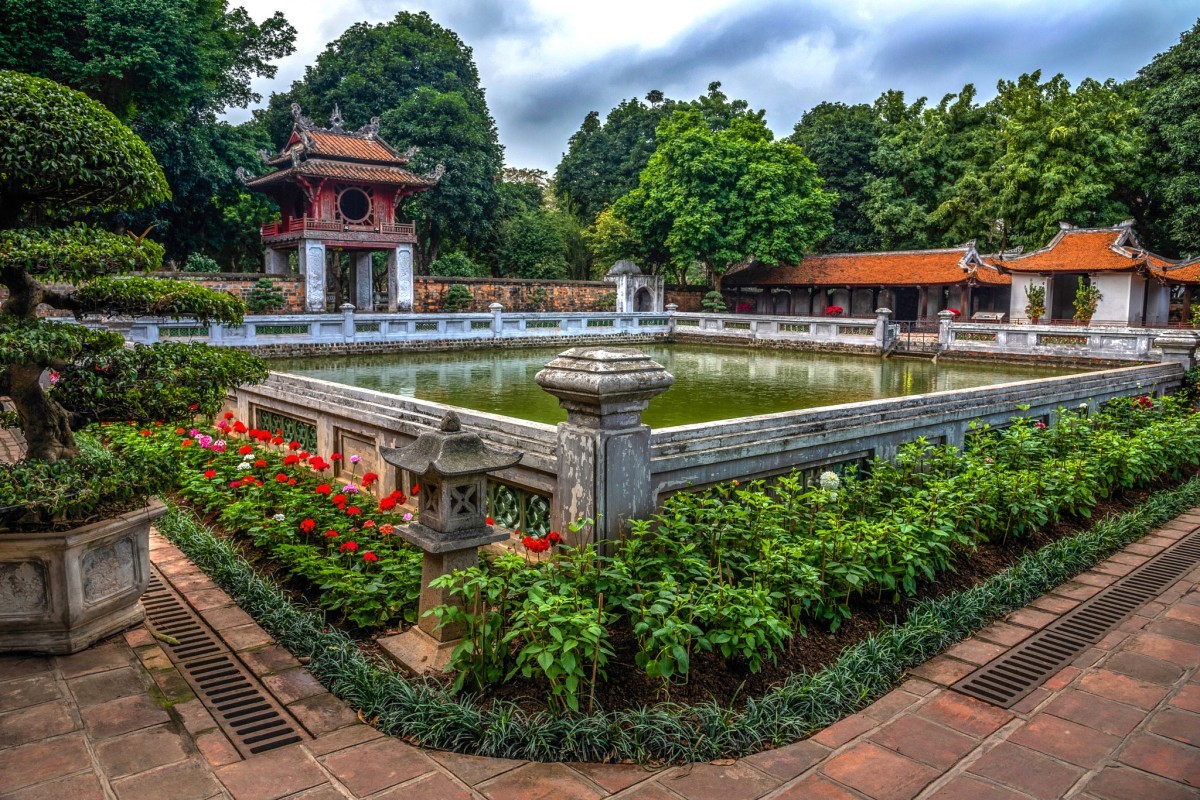


*The Constellation of Literature pavilion in the Temple of Literature – Quoc Tu Giam has been recognized as a symbol of Hanoi city.

Third zone

Including Well of Heavenly Clarity, with the square shape. The two sides of the lake are the Stelae of Doctors. Each stele is made of stone, placed on the back of a stone turtle, engraved with the name and position of the candidates who passed the great exam. The beer is placed on the back of a stone turtle. There are still 82 steles of the examinations from 1442 to 1779. These are the most precious relics of the Temple.
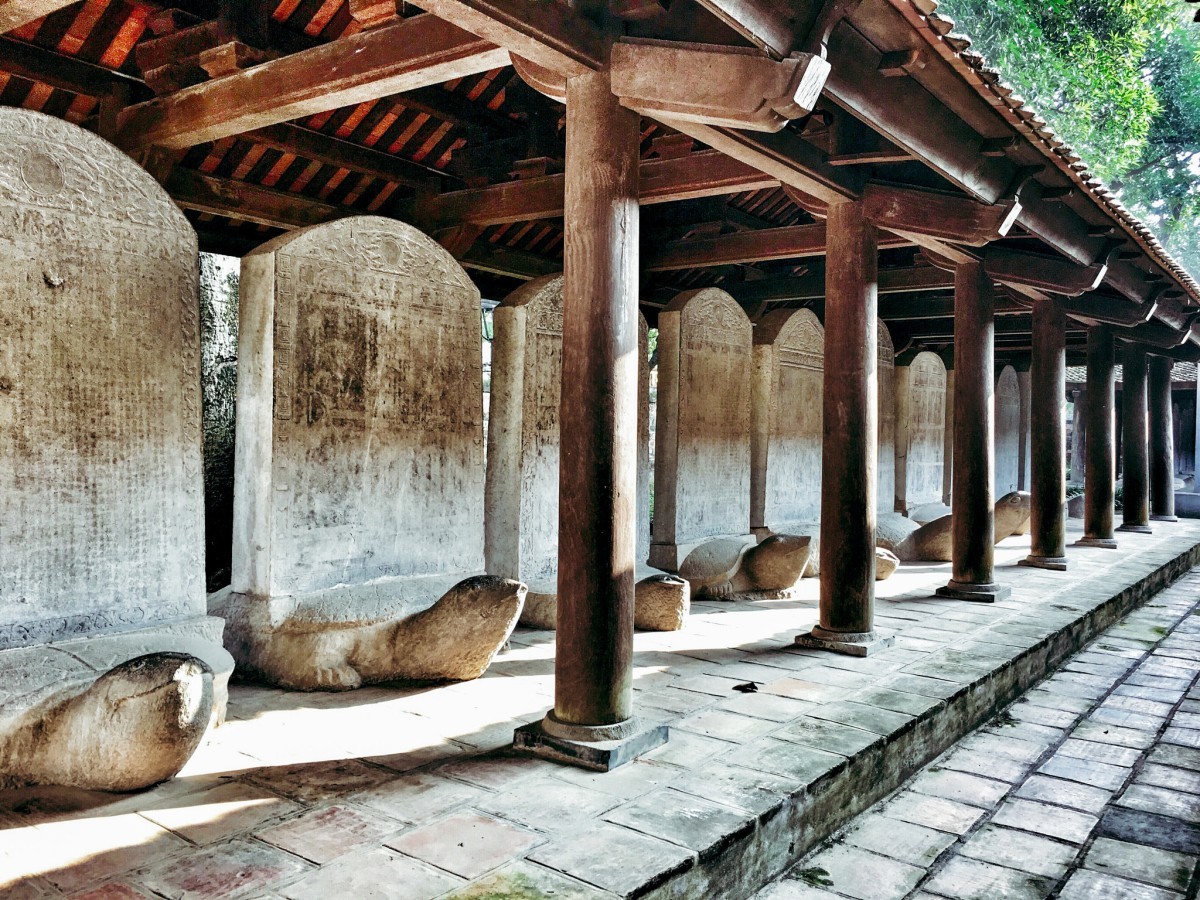


Fourth zone

It is the central area and the main architecture of the Temple of Literature, consisting of two large works arranged in parallel and in succession. The outer building is the House of ceremony, the inner building is the Upper Palace. This is the area to worship Confucius and Tu Phat (Nhan Tu, Tang Tu, Tu Tu, Manh Tu).


Fifth zone

Under the Nguyen Dynasty, the Quoc Tu Giam school in Hanoi was abolished, the ethnographer was changed to the Khai Thanh house, worshiping the father and mother of Confucius. However, this building was destroyed during the resistance war against the French. The new Thai Hoc Courtyard was rebuilt by Hanoi city in 1999. In this fifth area, there is also the Tien Duong – Hau Duong house, which is the place to worship the kings Ly Thanh Tong, Ly Nhan Tong, Le Thanh Tong and the private sector worship Chu Van An.


Meaning of Temple of Literature

Temple of Literature is not only the first university of our country but also like a burning candle, lighting up the studious tradition of the Vietnamese people. Coming here, you seem to be motivated by the brilliant gold panels of our forefathers, loaded with full energy to be confident in the journey of learning and discovering human knowledge.

Besides, today the Temple of Literature is also a place to organize poetry festivals, a place to commend outstanding and excellent students and a famous sightseeing place attracting a large number of domestic and international tourists. economy when coming to Hanoi. At the same time, this is also a meeting place to “ask for words” of the people of the capital during the traditional New Year holidays with the hope of a peaceful new year; or in the important exam seasons of the country with the belief of success of the “soldiers”.

Opening hours: 

- Open daily, including weekends or special holidays
- 8:00 to 18.00 (7:30 in winter)

Ticket price:

- 30,000 VND / person / visit.
- Free tickets for children under 15 years old

Note:

- Wear polite, neat, clean, dignified clothing
- Do not wear hats or smoke or carry flammable and explosive materials inside the Temple of Literature
- Only offer incense burning ceremony, only light 1 incense stick at the specified place
- Walk softly and speak softly to keep the environment clean
- Do not infringe on artifacts, do not write or draw, stand up, do not rub turtle’s head, Doctor’s stele and other exhibits
You might be interested

Hanoi Old Quarter or Hanoi French Quarter 2026: Where to Stay in Hanoi for the Trip You Actually Want

Choosing where to stay in Hanoi is really a choice between two moods. The city’s historic core splits into two neighborhoods that sit almost next to each other geographically but feel worlds apart in pace: the Old Quarter, loud and alive at every hour, and the French Quarter, elegant and unhurried.

5+ Hanoi Coffee Varieties: The Vietnamese Coffee Styles You Can Only Truly Taste in Hanoi

Coffee is not just a drink in Vietnam, it is a daily ritual, and nowhere is that ritual more inventive than in Hanoi.

Cốm Varieties Hanoi: The Best Specialties Made From Green Rice This Autumn 2026

Every city has a flavor that marks the turning of its seasons, and in Hanoi that flavor is cốm, the delicate young green rice flake harvested only in autumn.

Top 15+ Vietnamese Fruits You Must Try: A Seasonal Guide for Travelers

Vietnam’s long, narrow shape stretches across several climate zones, which means the country produces an extraordinary range of tropical and subtropical fruit almost year round.

Mắm Tôm Vietnam 2026: The Fermented Shrimp Paste Behind Vietnam’s Boldest Flavors

If you are curious about the more adventurous side of Vietnamese cuisine, mắm tôm is one of the most defining ingredients to understand.

Bún Ngan Hanoi 2026: Hanoi’s Comforting Duck Noodle Soup Every Traveler Should Try

If you are exploring Hanoi food beyond pho, Bún Ngan Hanoi deserves a spot on your list. This is a clear, fragrant noodle soup built around slow-simmered muscovy duck, known locally as ngan, paired with rice vermicelli, bamboo shoots, and a rich, house-made pork meatball called moc.

Tra Da Via He Hanoi 2026: The Iced Tea Culture That Defines Hanoi Street Life

There is a version of Hanoi that exists in guidebooks, full of temples and lakes and carefully curated itineraries.

Da Nang Vietnam 2026: Vietnam’s City of Bridges, Beaches, and Everything Between

Da Nang Vietnam sits on the central coast of Vietnam, sheltered to the north by the Hai Van Pass where a spur of the Truong Son range extends to the sea, and to the northeast by the forested Son Tra Peninsula reaching into the East Vietnam Sea, where three UNESCO World Heritage Sites sit within a 90-minute drive of each other.

Hue Vietnam 2026: Vietnam’s Imperial City and Everything Worth Knowing Before You Go

There are cities in Vietnam that surprise you, and then there is Hue Vietnam, which does something rarer: it slows you down.

Tam Dao Vietnam 2026: The Cool Mountain Escape Just Outside Hanoi

Eighty kilometers and roughly two hours from the heat and noise of Hanoi, there’s a town where the temperature drops ten degrees, clouds roll through the streets at eye level, and the architecture still carries the fingerprints of French colonial planners from a century ago.

A Traveler’s Guide to Hanoi History Museums 2026: What to See, When to Go, and Why It Matters

Hanoi rewards travelers who slow down enough to look past the lakes and street food stalls and into the rooms where the country’s modern story was written.

Why Does Every Street in Hanoi Old Quarter Have a Craft Name? The 1,000-Year Secret Behind “Hàng”

You’re walking down a narrow lane in Hanoi Old Quarter, weaving past a woman balancing a bamboo pole stacked with fruit, ducking under a strand of lanterns, and squinting at a street sign. Hàng Bạc. Then Hàng Đào. Then Hàng Mã. Then Hàng Thiếc.

Ho Chi Minh Mausoleum 2026: What to Know Before You Visit Hanoi’s Most Solemn Landmark

You’re standing in Ba Dinh Square at six in the morning. The sun has just cleared the rooftops. Red flags move slowly in the early breeze. Around you, a line of people stretches back across the square in near-total silence.

Áo Dài: Vietnam Traditional Costume and Where to Get One Made in Hanoi (From Luxury to Budget) 2026

You’re standing on a street corner in Hanoi’s Old Quarter at seven in the morning, coffee in hand, watching the city wake up. A woman glides past on a motorbike, her silk áo dài catching the light, the fabric rippling behind her like a brushstroke.

A Complete Guide to Traveling from Hanoi to Sapa 2026

The highland town of Sapa Vietnam sits about 300 kilometers northwest of the capital – far enough to feel like a different world, close enough to make a long weekend genuinely worthwhile. But that middle distance creates a real decision: how do you actually get there?

Mu Cang Chai 2026: A Travel Guide to Vietnam’s Most Breathtaking Rice Terrace Country

Some destinations earn their reputation through clever marketing. Mu Cang Chai earns it through sheer, undeniable beauty.

Sapa 2026: Your Highland Travel Guide for First-Timers

Somewhere between the mist rolling off a terraced hillside at dawn and the smell of corn wine drifting from a village kitchen, Sapa gets under your skin.

Hung Kings Festival 2026: From Hanoi to Phu Tho

Every spring, Vietnam pauses for a moment of collective remembrance during the Hung Kings Festival- a deeply meaningful national holiday that honors the country’s ancient origins.

Hanoi Old Quarter 2026: Where to See the City’s Soul

Few places capture the spirit of Vietnam’s capital quite like the Hanoi Old Quarter. With a history stretching back nearly a thousand years, this historic neighborhood remains the cultural heartbeat of the city.

TOP 10 BEST “Phở” shops in Hanoi you need to try

For a traveler in Hanoi, the scent of charred ginger and star anise defines the morning air. Pho is more than just a Vietnamese noodle soup; it is a cultural icon, consistently ranked among the world’s top culinary experiences by CNN Travel.

14+ Must-Try Dishes in Hanoi

Vietnamese cuisine has long been recognized as one of the world best cuisine for its balance, depth, and cultural richness.

TOP 7 MUST-VISIT TRADITIONAL CRAFT VILLAGES IN HANOI

Beyond the bustling Old Quarter, there lies a more profound side of the capital on the outskirt of the City.

Duong Lam Ancient Village – “Forgotten Old Town” of the capital

44 km from Hanoi, Duong Lam ancient village is the perfect choice if you are looking for a peaceful countryside to rest after the chaos of life.

Van Phuc silk village – A traditional cultural beauty from thousands of years

Talking about the beautiful and famous silk weaving village in Vietnam, we cannot help but mention the name Van Phuc silk village, with delicate embroidery lines and patterns.

Quang Phu Cau Incense village – a special beauty in the suburbs of Hanoi

Quang Phu Cau incense village in Hanoi has existed for more than 100 years, preserving the traditional incense-making profession, and is a beautiful check-in place that attracts tourists from near and far.

Hanoi Post Office: Three centuries ‘flowing’ through a name

Hanoi Post Office (also known as Bo Ho Post Office) is a work located opposite Hoan Kiem Lake, Hanoi, consisting of three post offices located at Dinh Tien Hoang, Le Thach and Dinh Le streets. , built in neoclassical and Art Deco architectural styles.

3 Jazz Bars for Jazz Lovers in Hanoi

Wandering in the middle of the city’s nightlife, it’s easy to see bustling, crowded bars and clubs. In the midst of the busy scene is the feeling of being alone, but the desire to find a place to belong.

Top 10 best cafe shops that you must visit when in Hanoi

Hanoi Cafe – If you are neither born in Hanoi nor a true connoisseur of cafe, Hanoi’s old cafes will still have a strange appeal. The feeling of sipping a cup of cafe in a tight space, looking out at the busy street with people passing by will linger in the hearts of anyone who has experienced it once.

Dong Xuan market – Hanoi’s biggest Trade market

As someone once said: “Whoever has the opportunity to come to Hanoi, if he has not been to Dong Xuan market, it is considered that he only knows a small part, a small corner, or has not been to Hanoi”.

West Lake – A romantic beauty in the heart of Hanoi

West Lake is one of the famous beautiful landscapes in Hanoi capital, where there are many historical and cultural relics associated with the history of formation and development of the ancient Thang Long Citadel and present-day Hanoi.

Hanoi Opera House – A French’s architectural beauty in the heart of Hanoi

After the French finished their invasion of Vietnam, they began to build a system of government throughout the country. In 1901, the French colonialists started construction of the Hanoi Opera House.

Saint Joseph Cathedral – Ancient architecture across 3 centuries

With bold French architecture, for a long time, Hanoi Cathedral is an ideal place for tourists from all over the world to visit. For Catholics, the Cathedral is a great place to attend Mass and pray.

Top 10 best places in Hanoi to watch fireworks display on Lunar New Year’s Eve

Only about 2 more months and Hanoi city will be filled with the idyllic, nostalgic and cozy atmosphere of the traditional Tet holiday. This will be the time when tourists can experience a very poetic, quiet, deserted Hanoi, far from the hustle and bustle of everyday life.
×

BEST PRICE HERE

Find a lower rate? We’ll beat it!
FREE 01 soft drink or local beer
20% OFF F&B services
20% OFF all Spa treatments
30% OFF Laundry services
FREE Early check-in & Late check-out (subject to room availability)

BOOK NOW
×